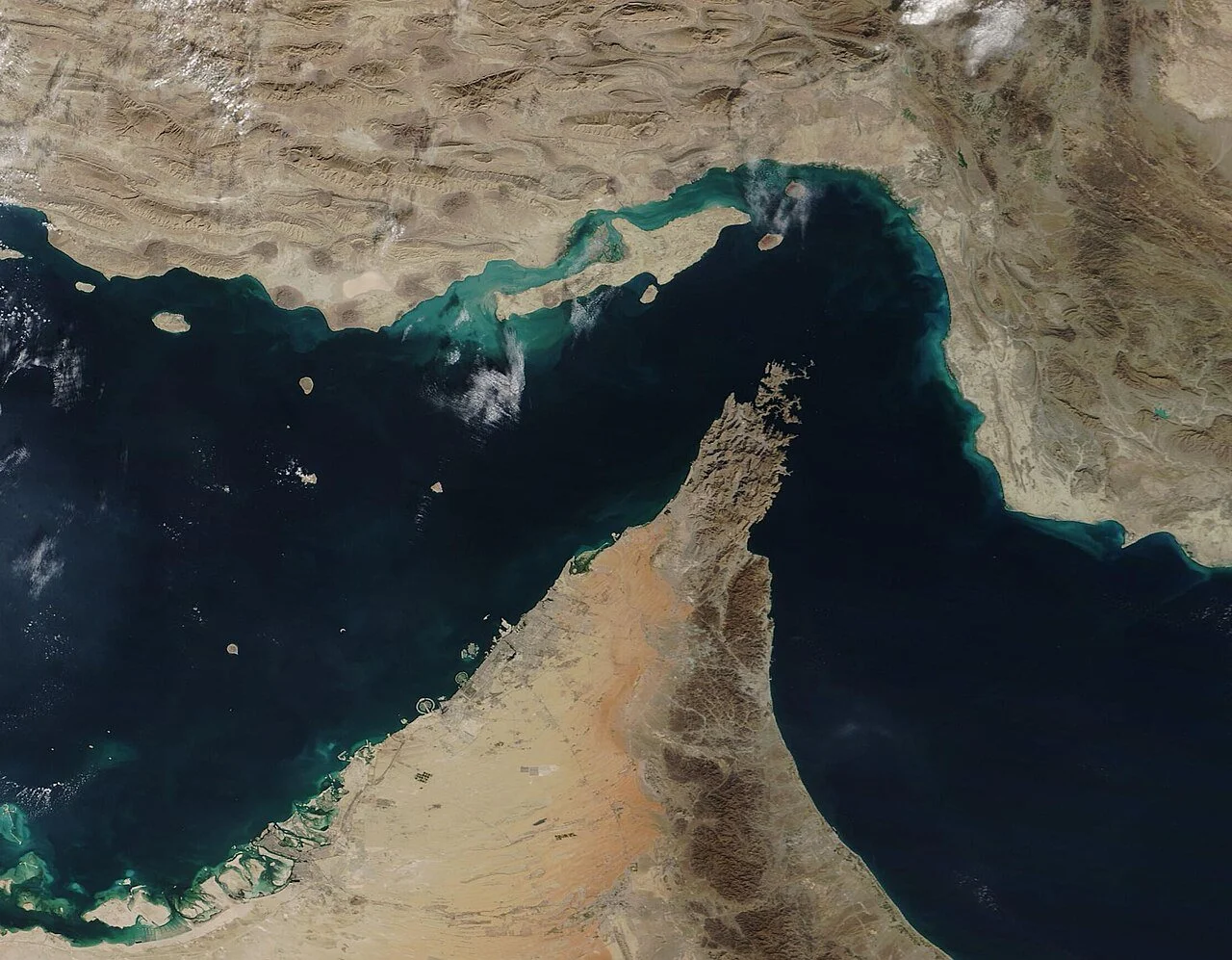
Do conflicts involving small nations drag in the major powers, and how likely is it that the conflict between Iran and Israel, with the United States, could draw in more states?
Commentary by Dr Rob Johnson, 23 March 2026
Perhaps the first thing to say is that Iran made a catastrophic strategic error in immediately internationalising the conflict with Israel and the United States by attacking almost all the oil producing states within range. At a stroke it converted a limited conflict into a regional one, and effectively set multiple nations against it. Moreover, despite the reluctance of Europeans to get involved, they could not avoid the consequences of Iran’s actions because of their dependence on supplies of Gulf oil and gas. The UK Prime Minister repeated several times in his public addresses that his country was ‘not involved’, even though its sovereign bases at Cyprus came under attack. The UK government has persisted with its self-inflicted wound of taxing oil companies and denying further exploration of its own reserves of oil and gas, prompting President Trump’s severe criticism of the British leader.
The second point is that it is curious that the Administration did not consider the strategic options for Iran, particularly with regard to Hormuz, before the conflict got underway. Was the reasoning that, with a swift decapitation, the regime would fall? Or was it that Iran would not consider trying to close the Straits of Hormuz because that would simply bring in the Gulf States, who would, instinctively, act in their ‘national interests’ and join the US and Israel? If these were considered, and I cannot believe the Pentagon did not, why were there not military measures focussed on the Straits as there were on Tehran?
Can the war draw in other powers, and are there historical precedents? The answer is yes. Alliance obligations are usually invoked, but there can be hard national interests in play. The British, for example, felt compelled to join the First World War, not because of their close relations with France (there was no formal alliance before 1914), but because the invasion of Belgium threatened to place German naval bases within striking distance of the UK. There was also a principle at stake – the same one that led the British to be the strongest advocate for aid to Ukraine in 2022 – that the right to self-determination had been breached by an illegal and unprovoked war of aggression. The same principle was applied in World War II: the British, as Victor Davis Hanson has pointed out, went to war for a principle, not because they were under attack.
The United States joined the war in Europe in 1941, after the Japanese attack on Pearl Harbor because of a German declaration of war but also because Roosevelt recognised it was in America’s national interests to prevent the German domination of Europe and possibly the entire Middle East, the seat of one of the largest reserves of oil.
There are countless examples of these alliance obligations, principles, and hard national interests played out across history, in Europe, in Asia, in the Americas, and in Africa.
Could this apply to the war in the Gulf? Wars are dynamic. It is very hard to give firm answers. Each of the major powers, and other nations, will each be making calculations of cost-benefit, risk analysis, reputational costs and gains, opportunities, and geostrategic limits. Above all, decisions will be based on domestic considerations too: what is the appetite for intervention or non-intervention? One thing is very clear and that is the absence of the United Nations. Already a somewhat defunct body, the UN has no influence in Washington, in Tehran, or in Tel-Aviv. Indeed, in the case of Iran and Israel, the UN has been so consistent in criticism that it has no leverage at all with either of them. Russia and China, as members of the UNSC, are themselves in breach the UN charter, in spirit and in fact. Moscow and Beijing are acting in their own interests and not those of any international body. This should not be a surprise given their track record over the last two decades.
Indeed, it is likely that Russia and China will see an opportunity to facilitate the Iranian strategy of protraction. They will try to supply Iran with arms and munitions. They will be eager to see Tehran regenerate its forces if the war is terminated suddenly.
By contrast, the United States is seen as having offended its European allies over the last few months, not least over demands to take possession of Greenland, the criticism of NATO (an alliance where members all pay and it is not a case, as the White House claims, that Americans pay for the defence of Europe: it’s the other way around. America gets 3.1 million allied personnel for free, along with two nuclear arsenals, several fleets, six land Corps, and a large air force), and even an insult to British troops who fought alongside America, when they were called upon to assist in Iraq and Afghanistan. The claim was they were ‘not really in the front line’. One recalls the faces of all those killed in action, defending forward operating bases, patrolling, and operating at low altitude, and thinks of their families. To insult those men and women is simply unforgiveable. Fortunately the alliance runs deeper than misplaced or ill-judged words.
Iran has no allies, but it has backers. We will not see the Chinese or Russians deploying troops to Iran. But we will see arms and equipment perhaps. Israel has the backing of the United States, and America is the preponderant global power. But, the Gulf States will not provide ground forces and, short of a ground invasion, there does not seem to be a way to end this conflict as one of ‘unconditional surrender’. If the general reluctance to participate continues (if there is no egregious Iranian attack directly on states outside of the Gulf), then the war is likely to remain limited. The principle of dealing finally with a terroristic regime does not seem to have motivated participation. Interests in energy supply have been badly affected, so this might be the most likely issue to draw in other powers.
The best way to avoid this sliding further into a war of states backed by the major powers, like the Iran-Iraq War of the 1980s, which lasted almost a decade, is to find a negotiated end with the exhaustion of Iran, which occurred in 1988. The chances of a prolonged war are, nevertheless, very high.