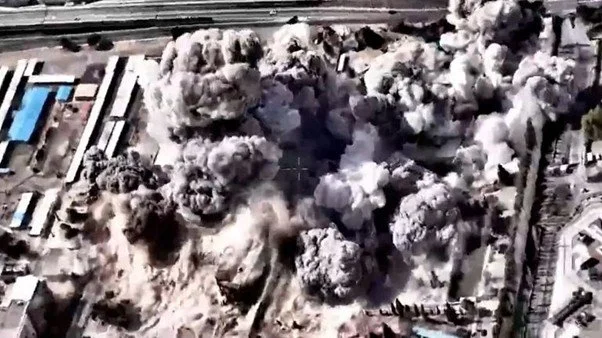
Prediction is, of course, an uncertain business. It is very hard to see how the war in the Gulf, which began at the end of February 26, will pan out. One can look at the asymmetry of intentions and capabilities to determine which side possesses the strategic advantage, but in all calculations one has also to include chance events and the friction which inevitably accompanies all wars.
The priority of the Islamic Republic regime is simply its survival, not only against America, Israel, and the Gulf states, but also against a significant proportion of his own people. While its rhetoric promises ‘crushing blows’, its capability is far less. Russian and Chinese made air defence systems have proven inadequate against advanced American and Israeli aircraft. While it will continue its drone and missile salvos in the short term, it may find it more difficult to sustain intensity, and therefore opt instead for a periodic set of attacks, but on a large enough scale to attempt to overwhelm missile and air defence systems across the Middle East.
America has the capability to sustain operations for some time, and it retains the initiative in terms of deciding when to cease its campaign. The absence of ‘boots on the ground’ avoids the sort of commitments that characterised the wars in Iraq and Afghanistan.
The key factor is likely to be economic rather than military. The hesitancy of tanker fleets to navigate the Straits of Hormuz may well be resolved by American military preponderance as they destroy missile batteries, but, as the Houthi interdiction of the Red Sea indicated, Iran need only attack a handful of ships to cause significant financial damage. If oil supplies are held up for some time, one would expect an increase of oil prices, and, already, just two days after the outbreak, crude prices were reported to be 13% higher. These higher prices will have a significant impact on Europe, the UK, and India. China may also be badly affected. Overall, it is possible that we will see an economic downturn facilitated by high inflation. In the UK, which already has very high energy costs, the effect may be more striking.
American companies may benefit from the higher oil prices, as will those in Russia. This will be important to Moscow because its revenues have been severely depressed, and the Europeans were showing signs of interdicting the so-called shadow fleet of tankers. Higher oil prices will give Putin greater leverage and allow him to continue his war in Ukraine.
In terms of potential pathways and outcomes, it could be that the Iranian regime collapses and that the war is concluded. A realignment of Teheran towards the Gulf states and America would be a very positive outcome indeed. It would secure global oil supplies, and deprive Russia of a key belligerent partner. Across the region, many would breathe a sigh of relief in that the sponsorship of extremist movements would be curtailed. Hezbollah and the Houthis would be far less effective.
On the other hand, the Iranian regime may survive, and, when the conflict comes to an end, it would turn its guns on those that have protested. Like the Chinese crackdown at Tiananmen Square, Iranian democracy might be short-lived. In the aftermath of the war, under these conditions, proxy militias in Iraq, in Syria, in Yemen, and elsewhere would be reactivated and continue their dreary, predictable, and murderous campaigns of terror the years to come.
A worst-case scenario would be that America is drawn into the conflict for many months, the costs spiral, oil prices skyrocket, and China and Russia step in to supply Iranians with missiles and munitions. In this situation, the UK would potentially relive 1973 ‘oil shock’ and subsequently endure a decade of stagflation.
As so often in war, once committed, it is better to see it through and to allocate all the resources required from the outset. Already, the Prime Minister's attempt to limit involvement has failed. A legalistic approach did not survive armed attacks on UK bases or those of its partners and allies. However, the unspoken damage is that the United States no longer regards Britain as a reliable ally. While British commentators have pointed to the way that the White House has diminished the UK, not least accusations that Britain did not make a full front-line commitment to the war in Afghanistan and Iraq, and the irritation of tariffs, the Americans are at least in agreement that the British should assert their own national interests. These interests are clear. UK is still dependent upon hydrocarbons, the majority of which come from the Gulf region. It has long-standing allies there. Iran has been a threat to the UK's interests and personnel in the region for many years. British personnel have been killed by Iranian operatives and their proxies. It is not in Britain's interests for the Iranian regime to survive in its current form, nor is it acceptable that Iran, with a long history of fostering terrorism, should acquire nuclear weapons. The UK interests are also to uphold the concepts of self-determination and self-defence. Its partners in the region have been attacked without warning, and therefore the UK is obligated to assist them. Despite the utterances from number 10 Downing Street, the legal and moral position is very clear indeed.
Dr Rob Johnson
2 March 2026