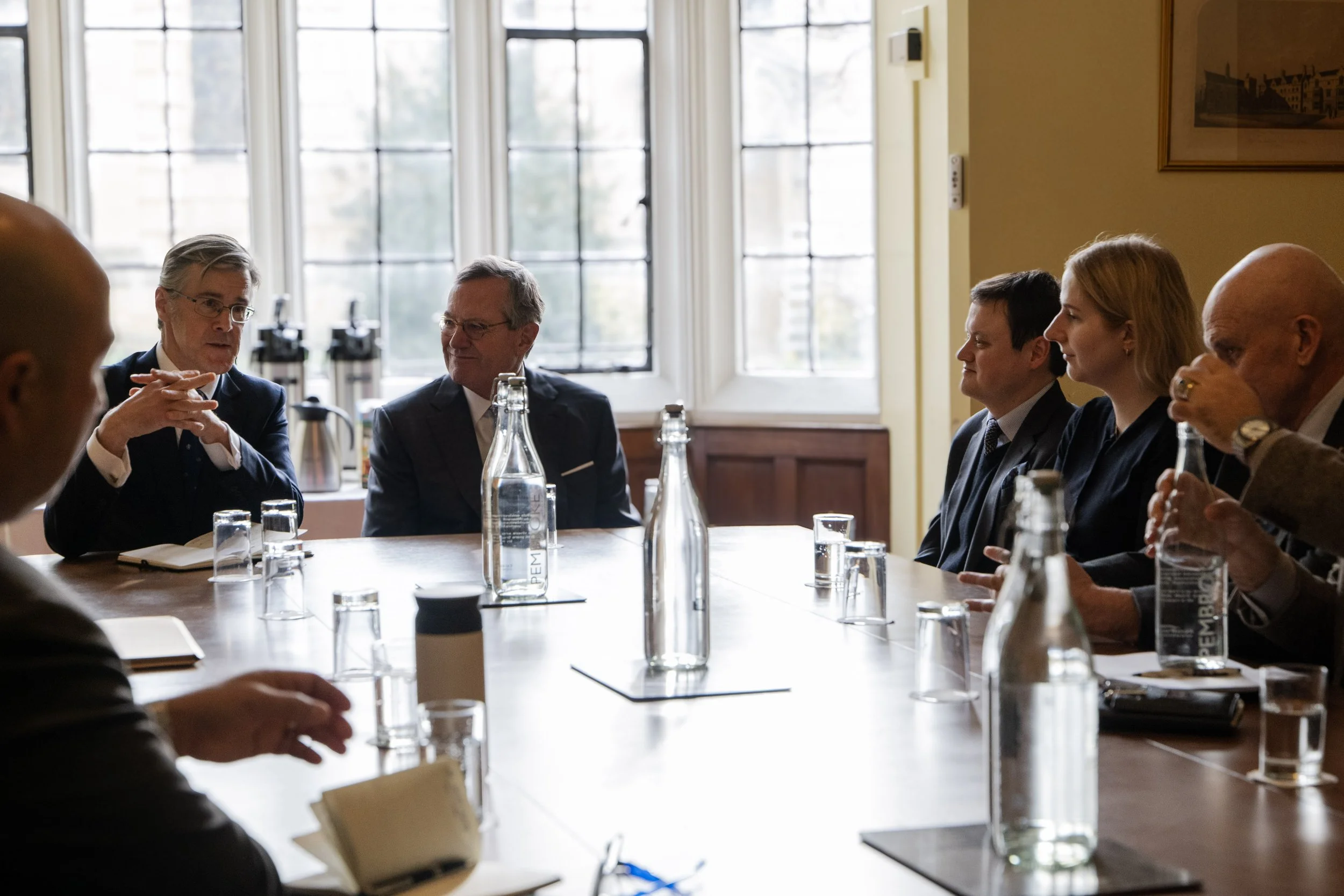
The US Ambassador visited Pembroke College on Tuesday 17th February. Ambassador Warren Stephens spent time with the SST:CCW Visiting Fellows discussing our key research themes.
The main area for discussion with the SST:CCW researchers was US foreign policy, but there was also the opportunity to gain insights into the current position of the UK government on several issues, including security of research from hostile intelligence, energy policy, defence, relations with China, and the future of Chagos-Diego Garcia.
The Ambassador is on the record with his critical views on UK energy policy and he found agreement amongst British academics and military personnel present at the meeting. The implication for the United States is that the UK is currently saying it is unable to find more money for defence. This is a direct result of its energy policy and massive welfare bill. The UK doesn’t seem to grasp that high energy costs deters US investment.
On defence, the British and European researchers felt the UK is not spending enough and that its armed forces are hollowed out. The Ambassador was able to hear some of the concerns the SST:CCW team members have about Russian regeneration of force and aggression, largely by 'hybrid' means, including the threat to seabed communications and commercial infrastructure. There is a specific concern amongst UK veterans that they are being pursued by lawyers for prior service in counter-terrorism missions, with the government's legislative approval (Northern Ireland Troubles Bill). Dr Johnson is actively involved in trying to raise awareness of both and use academic studies and public broadcasting to interrogate these government policies, namely: to examine how to invest more in UK defence and to protect veterans so as not to deter recruitment into the UK armed forces.
The ambassador learned how Dr Johnson has an established strategic leaders' education programme, and will develop this year an intelligence leaders' programme. He is a frequent speaker at UK and NATO professional military education establishments and conducts research into the threats posed by Russia, China, and Iran to US and UK interests. SST-CCW has recently written a net assessment on the economic effects of a sudden or a protracted blockade of Taiwan on the UK and its allies. The effects, the Director told the ambassador, would be very damaging in both cases, not least as the UK has a 100% dependency on Chinese pharmaceuticals in the form of penicillin. China has previously threatened to reduce supply, which coerces the UK.
There was some discussion about consistency within US foreign policy. The Ambassador gave a clear and gracious defence of policy, and he heard that the speeches given by Mr Marco Rubio and Professor Elbridge Colby at Munich were extremely well received. All these had done much to allay European fears which had been exaggerated after US announcements about Greenland.
The Ambassador raised the question of migration as a challenge for the UK. Dr Johnson agreed and noted that the majority of the public are appalled by successive governments' failure to grip the issue. The sticking block is the European Convention on Human Rights (ECHR), which has, according to legal opinion, grown out of control. Two opposition parties in the UK wish to repeal the European legislation but the government feels compelled to retain it.
The Ambassador was very much liked. His modest manner and candour were deeply appreciated.